Fire Photoshoot Ideas (and How to Keep Everyone Safe)
Disolo Art · Updated
The best fire shoots use the flame as the light, whether it's a candle warming a face, backlit smoke or a bonfire at blue hour. Put one person in charge of the fire, and check Toronto's rules, because an open fire needs a permit or a booked pit.
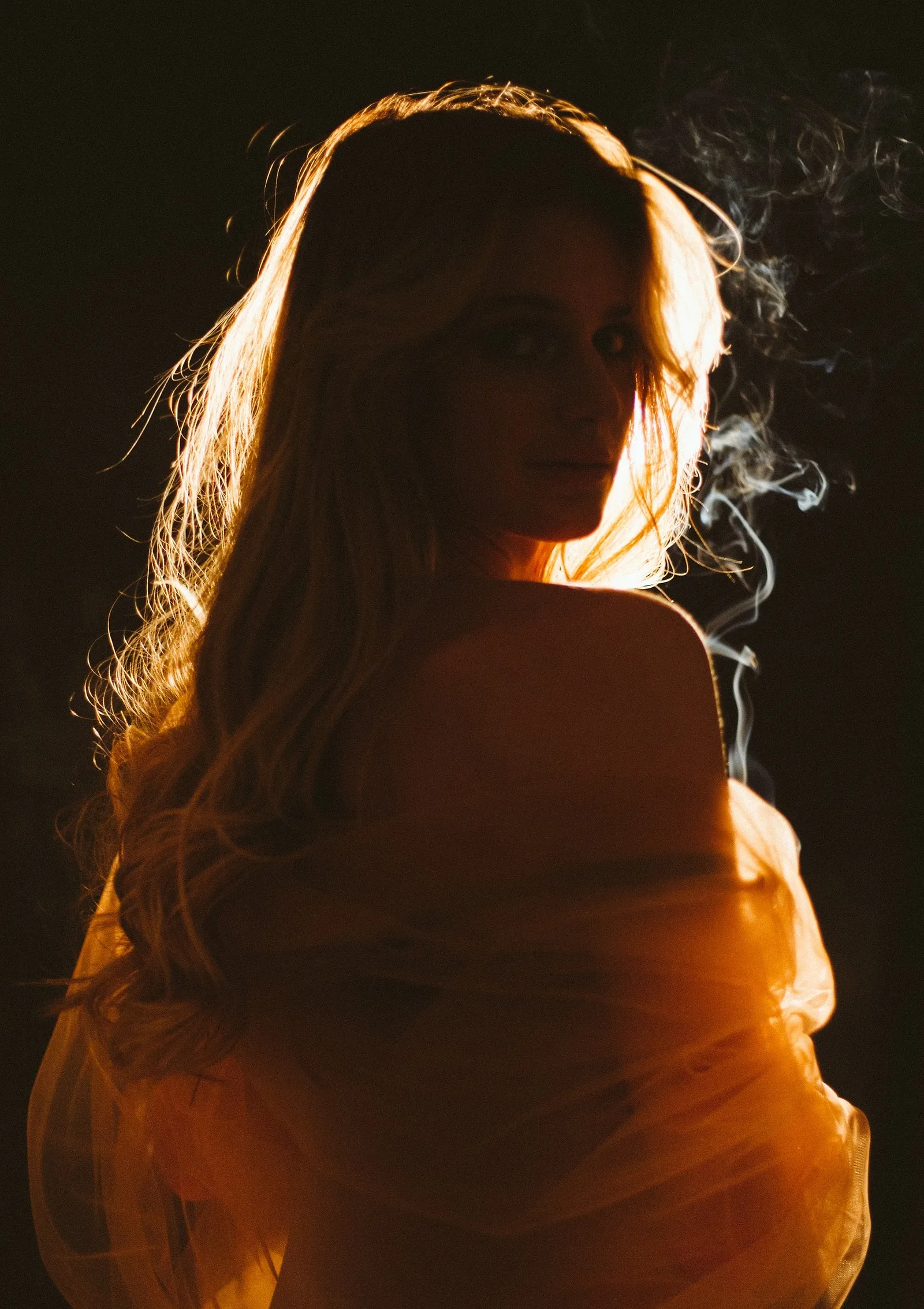
The best fire photoshoot ideas use the flame as a light source, not a prop. That can mean one small flame warming a face, or a glow from behind that turns smoke and sheer fabric amber. At the other end of the scale, a bonfire throws sparks into the night and turns everyone around it into silhouettes. Start small. Give one person no job but the fire, and keep an extinguisher and a fire blanket within reach. In Toronto, check the rules first. Open-air fires need a permit, and in City parks they're allowed only at a booked fire pit, or at another site with an extra form, an inspection and a fee.
What fire does as a light
Fire is a small, warm, flickering source. It lights only what is close to it and leaves the rest of the frame in darkness, which is exactly what we like about it. Our own stories use it two ways.
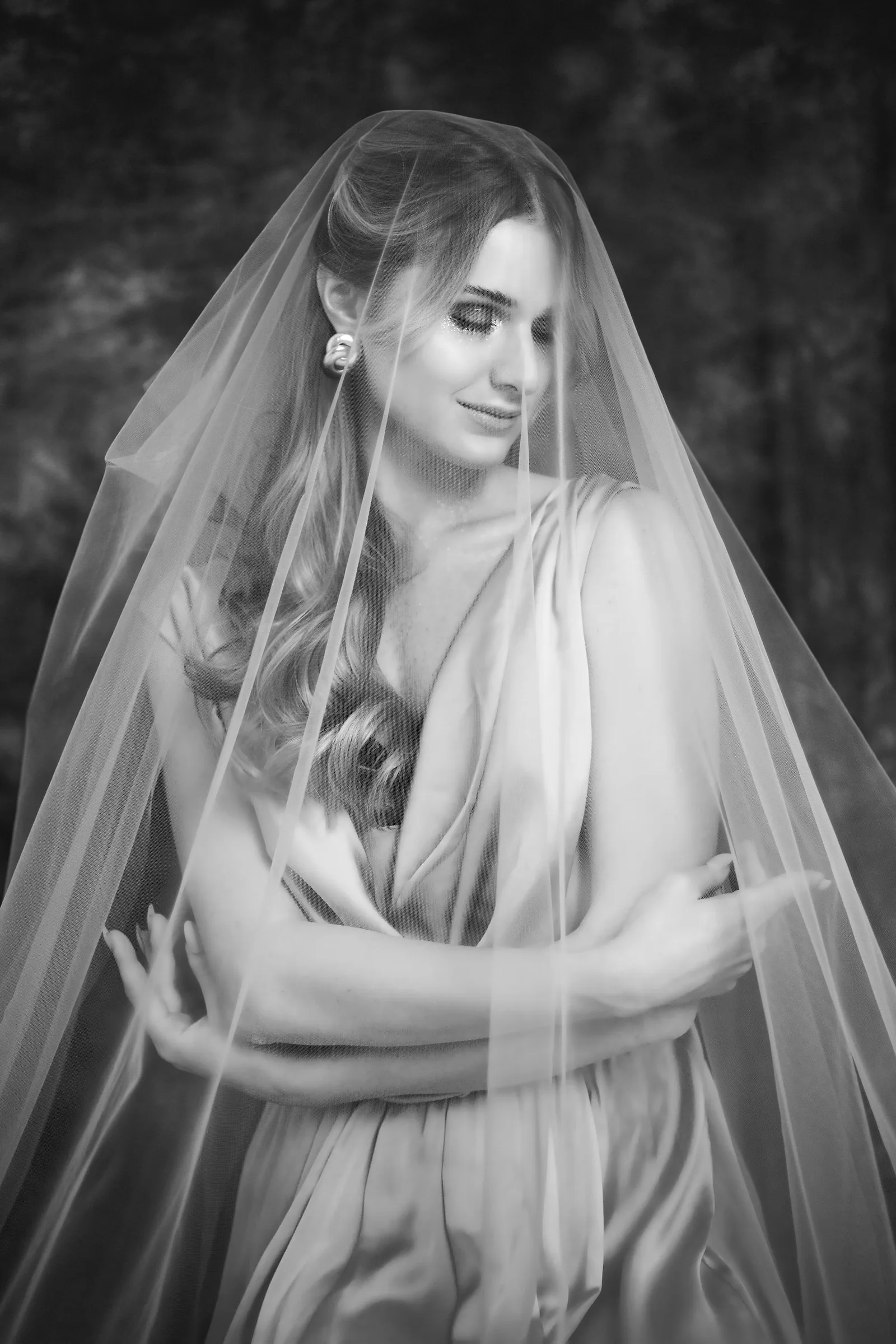
A small flame and a warm backlight. In one frame of Veil & Fire, she holds a burning stick of palo santo at chest height between herself and the camera. Palo santo is a fragrant wood made to be lit, and it burns slowly. The tiny flame is the brightest point in the picture and puts a faint warm glow on her face, while a strong warm light from behind outlines her hair and turns her tulle sleeves amber. The background stays black. In other frames from the same half, a thin line of smoke curls beside her, visible only where that backlight passes through it. Her hair is loose and her sleeves are sheer, the two things the checklist below keeps away from a flame. If you try this look, tie the hair back, pin the sleeves and give one person no job but the flame.
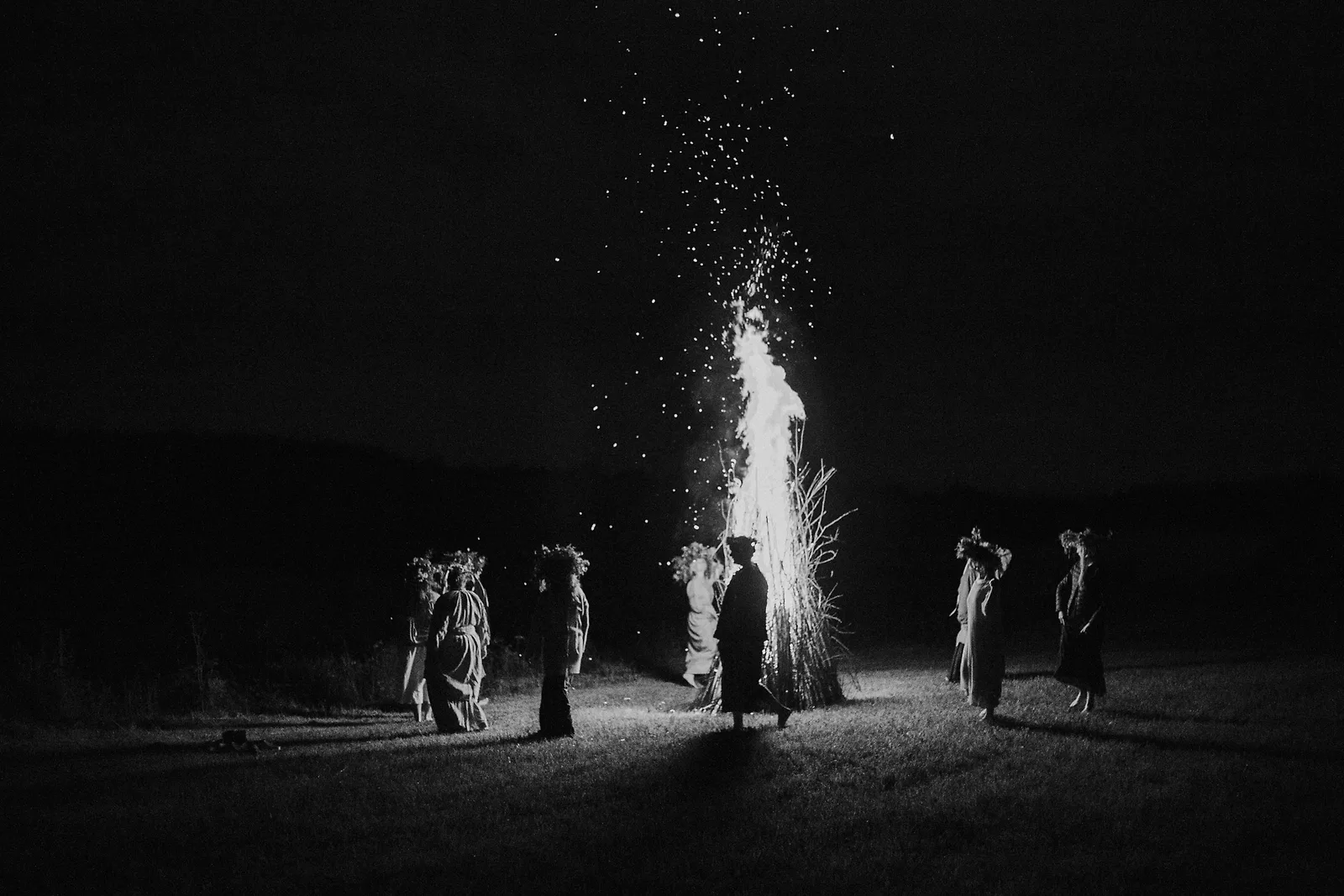
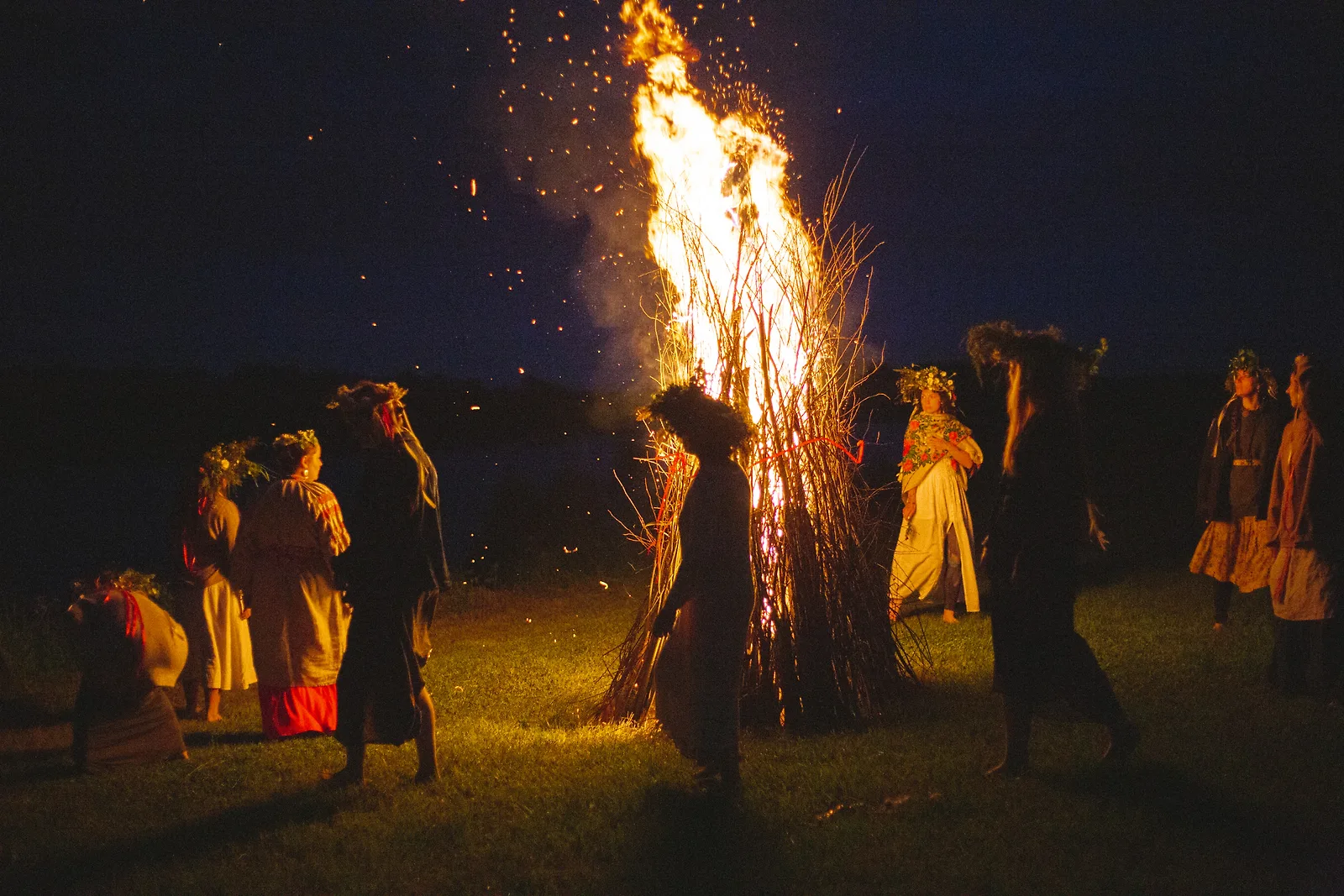
A bonfire as the only light. Midsummer Night is lit by a tall cone of branches burning in an open field. Sparks rise into a black sky, and wreath-crowned figures in long robes stand back from the fire in a loose circle. Each figure is lit from one side only, and long shadows run away from the flames across the grass. In black and white, the fire becomes pure white and the night pure black. On a shoot, keep everyone as far back as the figures at the edges of the circle.
10 fire photoshoot ideas
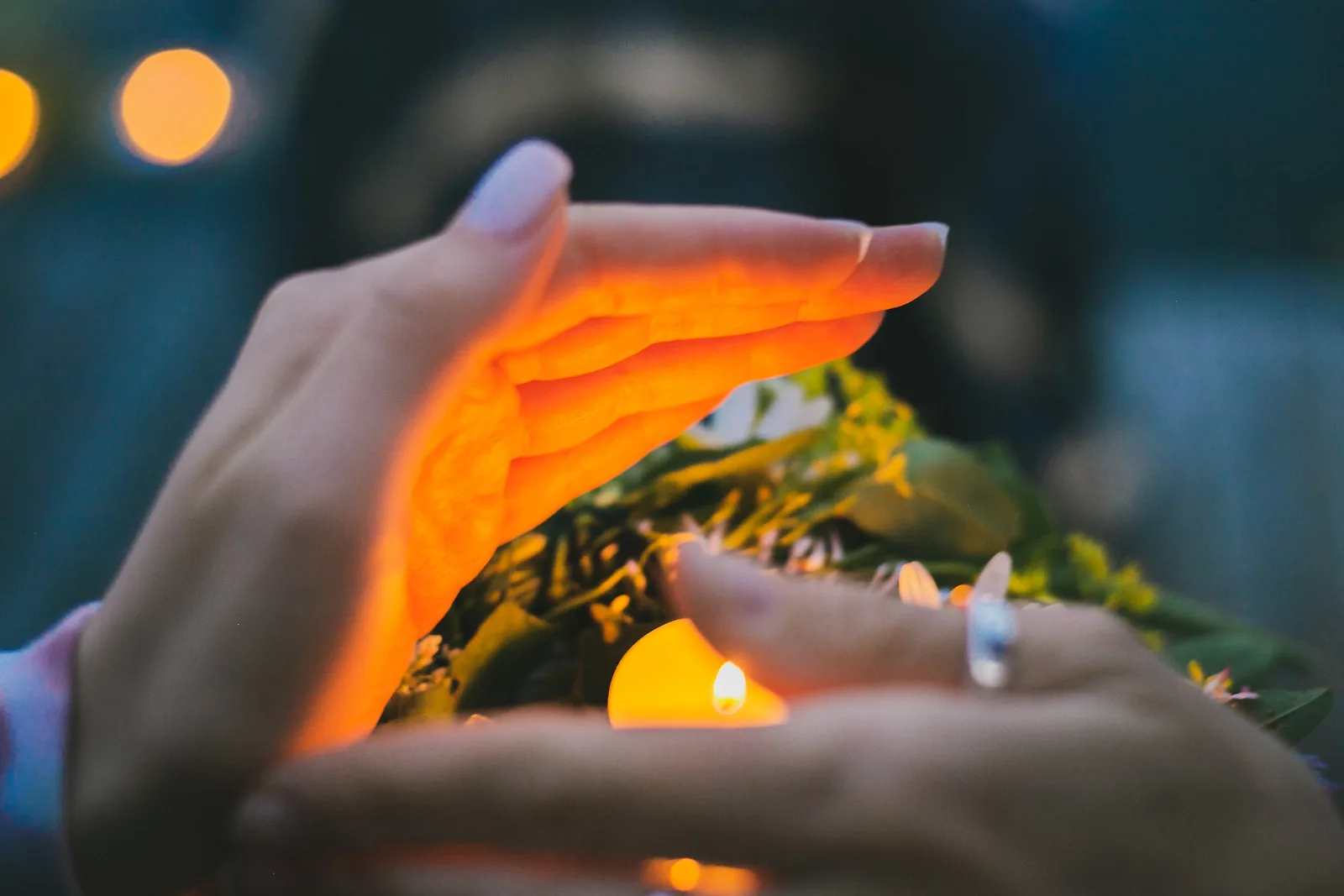
- One flame, one face. A candle in a holder, at chest height and a little to one side, in a dark room. Never put it straight under the chin, where it lights the face like a ghost story and sits within reach of the hair. The face picks up a little warmth and the flame becomes the brightest point in the frame. Tie the hair back and pin the sleeves well clear.
- Backlit smoke, no open flame needed. Put a warm light behind your subject and add a little smoke or haze. Lit from behind, smoke glows; lit from the front, it disappears. Ask the venue first, because haze can trip smoke detectors.
- The firelit circle. People standing back from a bonfire, lit from one side, with long shadows across the ground. A wide lens and a low camera show the circle and the sparks above it.
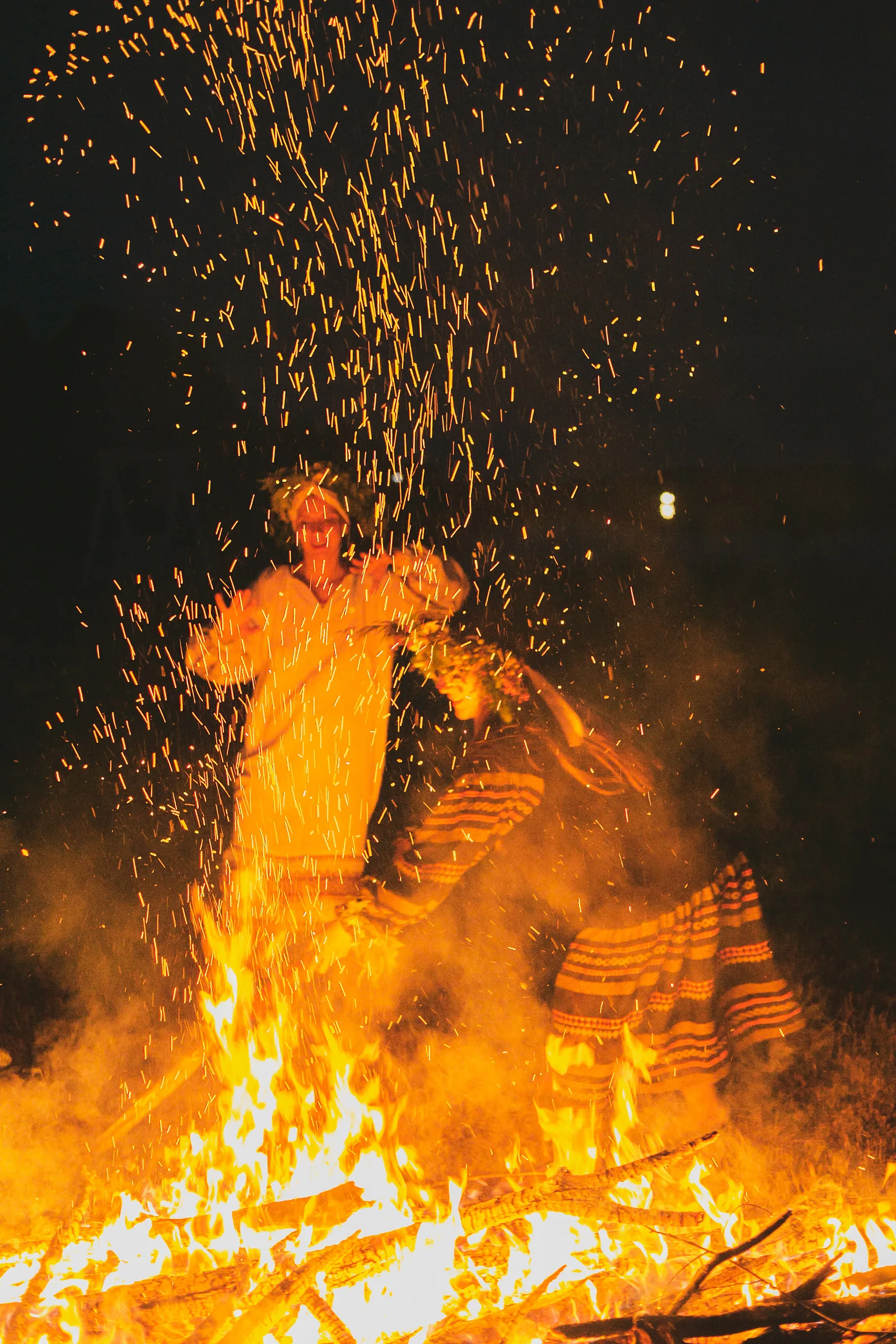
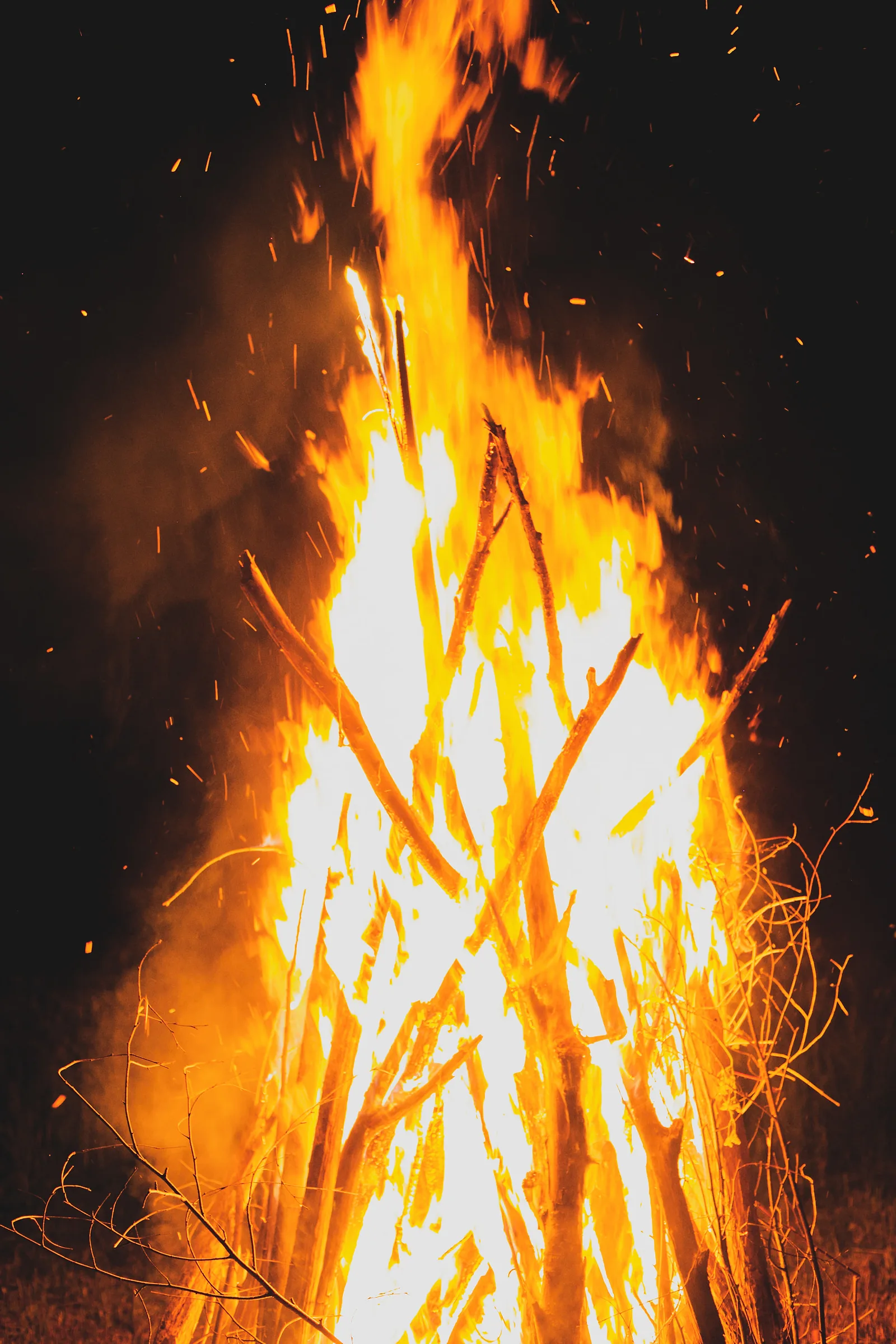
- Sparks into the night. On a tripod, at 1/4 s to 1 s, rising sparks turn into streaks of light above the fire. Keep a person still at the edge of the frame for scale.
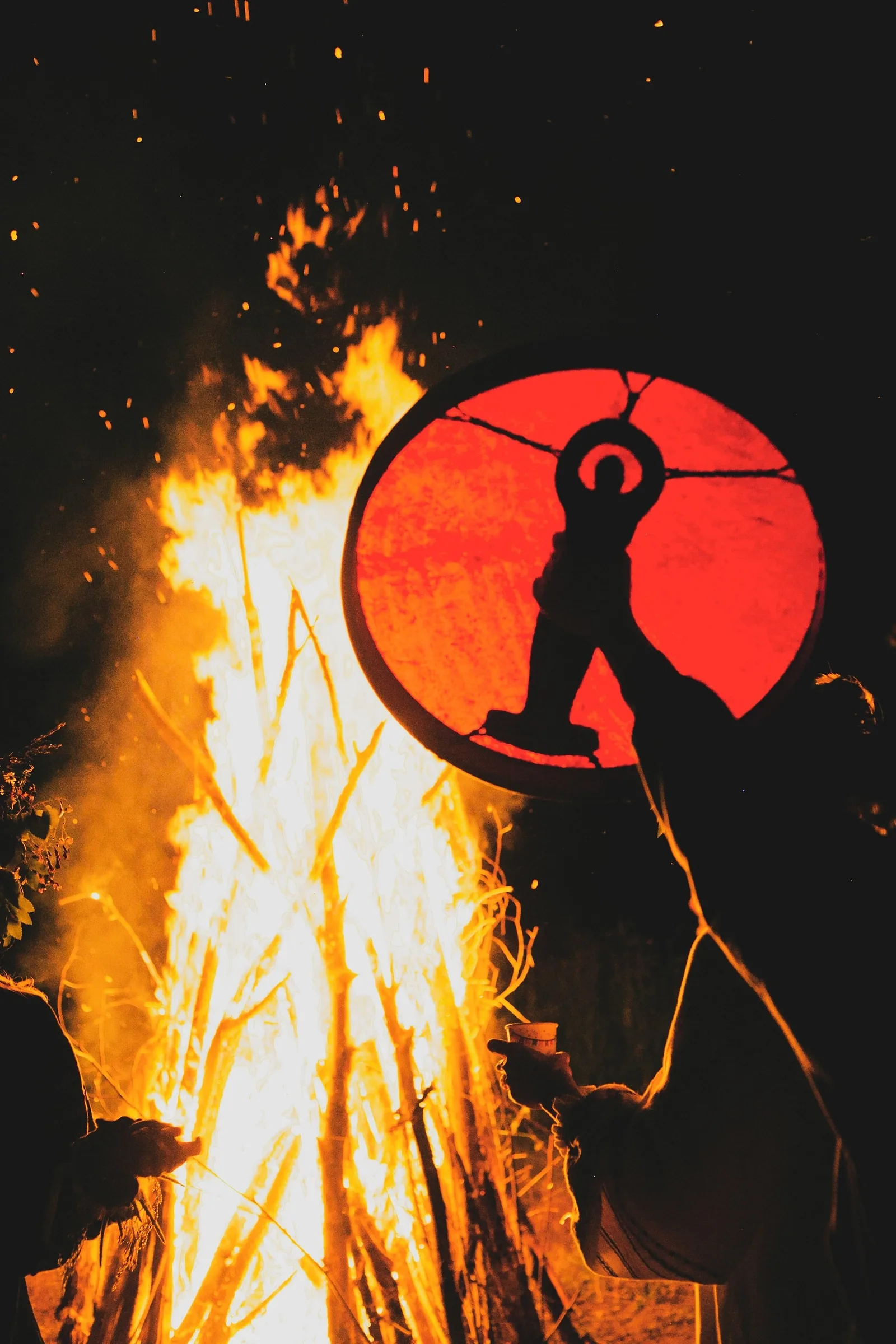
- Through a glowing object. In Midsummer Night, a frame drum raised in front of the fire glows red, because the firelight shines through its skin. Translucent things held between the fire and the camera, at a safe distance from the flames, glow in the same way. Keep them in front of the fire, never over it.
- Blue hour by the fire. Leaf wreaths, white linen and a fire lit just as the sky turns deep blue. Warm firelight against a cold sky is one of the strongest colour contrasts you can get outdoors, and it doesn't last long. In a City park, plan it for September or October, when blue hour ends before the 8:30 p.m. end of park fire hours (on September 1, sunset is at 7:53 and blue hour ends at 8:23). In midsummer you'd need private land and a Toronto Fire Services permit.
- A flame in the foreground. Hold a candle or a lighter near the lens, well out of focus, and frame the subject through its glow. The flame stays with the photographer instead of the model, which makes it one of the safest fire looks.
- Fire without fire. A projector throwing flames on a wall, LED flame lights or an orange gel on a lamp. You get the look anywhere, without a permit or any risk.
- Patio fireside. In Toronto, a ULC- or CSA-approved propane or natural-gas fire table is allowed on your own patio without a permit, as long as it's supervised. Wood fire pits are not allowed. Shoot it at dusk for warm faces and a blue sky.
- Sparklers, on the right day. Sparklers count as fireworks in Toronto. Without a permit you can light them only on your own property on Victoria Day and Canada Day, until 11 p.m. Write in the air with a slow shutter (one to four seconds) and keep a bucket of water for the hot wires.
Posing near fire. Keep the flame below the face and to one side, with elbows in and sleeves pinned back. Tip the chin slightly down and look past the flame rather than into it.
Camera settings for fire photos
Firelight is dim and very warm, and the flame is far brighter than anything it lights. Expose for the face, not the fire.
- Meter the lit side of the face (spot metering) and start from that reading. Let the flame itself clip to white; if the glow around it burns out too, take off a stop.
- A candle or small flame close to the face: start around f/1.4–f/2, 1/125 s and ISO 1600–6400.
- A bonfire with people a few metres away: start around f/2.8, 1/250 s and ISO 1600–3200.
- Spark trails: a tripod, f/8, 1/4–1 s and ISO 400. All three are starting points; the size of the fire and your distance change them.
- Shutter speed changes the fire. At 1/250 s or faster you freeze the shape of the flames; slower than about 1/30 s they turn into soft glowing ribbons, and sparks become lines.
- White balance by hand. Firelight is about 1,900 K, far warmer than a household bulb (about 2,700 K). At the Tungsten setting (about 3,200 K) it still looks deep gold, which is often the point; if skin turns too orange, go down toward 2,500 K. Daylight (about 5,500 K) makes it deeper orange still. At blue hour, a setting between Tungsten and Daylight keeps the fire warm and the sky blue. Shoot RAW so you can adjust it later.
- Focus on the lit edge. Autofocus hunts in the dark, so focus on the bright rim of the face or hair, or switch to manual focus.
- Try black and white, as we did for Midsummer Night: the fire turns pure white and the night pure black. It hides mixed colour and makes the shapes graphic.
Safety first: the fire-shoot checklist
- One person whose only job is the fire. Not the assistant holding a reflector, and not the photographer.
- An extinguisher and a fire blanket within reach, plus a bucket of water or sand. Agree beforehand who uses them.
- A first-aid kit. For a burn, cool running water for at least 20 minutes; no ice, butter or creams.
- Check the wind. City park fires are not allowed when the wind is over 25 km/h, in rain or fog, or during a smog alert. Those are good rules anywhere.
- Keep your distance. At a designated park fire site, the City requires 6 metres of clearance from anything combustible, including overhanging branches. Keep people back from the fire too, and never downwind of the sparks.
- Hair tied back, with no hairspray near the flame.
- Watch the fabric. Light, loosely woven, flowing fabric (tulle, chiffon, a veil, wide sleeves) is the real risk, whatever it's made of. Health Canada notes that the more loosely woven and lightweight a fabric is, the more combustible it is, and that synthetics tend to melt and drip. Keep sheer pieces well away from open flame.
- If clothing catches fire: stop, drop and roll, and smother the flames with the fire blanket.
- Never on a shoot: fire breathing, burning newspaper or hair, lighter fluid on a lit fire, or anything thrown into the flames.
- No steel wool. Spinning burning steel wool throws hot sparks far beyond the frame, onto grass, roofs and people nobody is watching. We don't recommend it at all. Outdoors in Toronto it counts as burning outside a building, so the City's open-air burning rules cover it.
- Indoors, follow the studio's rules. Candles stay on a stable, non-combustible surface away from fabric, and smoke or haze needs the venue's permission.
Fire photoshoots in Toronto: what the rules say
This is as of October 2026 and isn't legal advice, so check the linked City pages before you plan.
- Open fires need a permit. "Open air burning is not permitted" in Toronto without a permit, and Toronto Fire Services inspects the site before issuing one. Small, supervised cooking fires on a grill, barbecue or spit are the exception.
- Backyards: wood-burning fire pits, chimineas and fire bowls are not allowed. Approved propane or natural-gas fire pits are allowed without a permit if they're used outdoors and supervised.
- City parks: the parks bylaw forbids an open fire or bonfire "unless authorized by permit". You can book one of the City's designated fire pits ($34.33 for up to 25 people, $112.57 for 26 or more, plus HST). A pit that isn't designated takes an extra form, an inspection and a fee. Park fire hours are 10 a.m. to 8:30 p.m. unless posted otherwise, so plan for dusk, not midnight.
- A hired shoot in a park also needs the City's commercial photography booking, which is a separate permit.
- Shoots with fire or effects: the Toronto Film Office requires a location permit and Toronto Fire Services or police approval for productions using fire, special effects or pyrotechnics, even on private property. Special-effect pyrotechnics need a federally certified operator.
- Fireworks and sparklers: allowed without a permit only on your own property on Victoria Day and Canada Day, until 11 p.m. Any other day needs a permit ($226.37 in 2026, requested ten business days ahead). They are never allowed in parks, on beaches, on streets or in parking lots. The bylaw also lists smoke bombs among prohibited fireworks, so ask the City before you buy coloured smoke.
- Provincial fire bans apply to Ontario's northern fire region, which doesn't include Toronto. The City's own rules apply all year.
For permits in general, from parks to private venues, see our Toronto photoshoot permit guide.
FAQ
Can you have a bonfire in Toronto?
Not without a permit. Open-air burning isn't permitted in the city. In parks you can book one of the City's designated fire pits, and other exceptions need a Toronto Fire Services permit.
Can I have a fire pit in my backyard in Toronto?
Not a wood-burning one. Wood fire pits, chimineas and fire bowls aren't allowed, but a ULC- or CSA-approved propane or natural-gas fire pit is fine without a permit if it's used outdoors and supervised.
Are sparklers allowed in Toronto?
Without a permit, only on your own property on Victoria Day and Canada Day, until 11 p.m. Sparklers count as fireworks, so any other day needs a permit, and they're never allowed in parks, on beaches or in streets.
What camera settings work for fire photos?
Expose for the light on the face and let the flame itself clip to white. Start around f/2, 1/125–1/250 s and ISO 1600–3200, and check the face on the histogram. Shoot RAW and set the white balance by hand.
Is steel wool photography safe?
We don't recommend it. The sparks fly far beyond the frame and land where nobody is watching, and outdoors in Toronto it falls under the open-air burning rules, which require a Fire Services permit.
Planning a shoot with fire
Our editorial photoshoot ideas show how Veil & Fire was built from concept to light, and Midsummer Night is the kind of festival and cultural work on our event photography page. Have an idea with a flame in it? Tell us about it.
Sources
All as of October 2026:
- Open-air burning, permits and gas fire pits: City of Toronto, Open Air Burning and the City's Open Air Burning information sheet
- Fires in parks: Toronto Municipal Code, Chapter 608, Parks; booking a fire pit; fire pit fees; fire conditions and hours
- Commercial photography in parks: City of Toronto
- Shoots with fire or effects: Toronto Film Office, Plan Your Shoot; Natural Resources Canada, special effect pyrotechnics
- Fireworks and sparklers: City of Toronto, use and disposal of fireworks; Toronto Municipal Code, Chapter 466, Fireworks
- Fabric flammability: Health Canada, textile flammability guide; stop, drop and roll: Health Canada, fire safety
- Ontario's fire region: Ontario, outdoor fire rules and permits