Horse Photoshoot Ideas for Cinematic, Safe Equestrian Portraits
Disolo Art · Updated
Mix wide golden-hour frames with close portraits, details and one moment of movement. The owner holds the lead for every frame, and your outfit should suit the horse's coat.
The horse photoshoot ideas that work best follow what a calm horse does anyway, like standing close, turning its head toward you or walking beside its person in low sun. Plan a mix of wide golden-hour frames, close portraits, small details and a single frame of movement. Keep the horse's owner or handler on set the whole time, and dress in colours that suit the coat. Below are ten ideas with frames from our story The Rider, then the safety rules, outfits and light that make them work.
10 horse photoshoot ideas
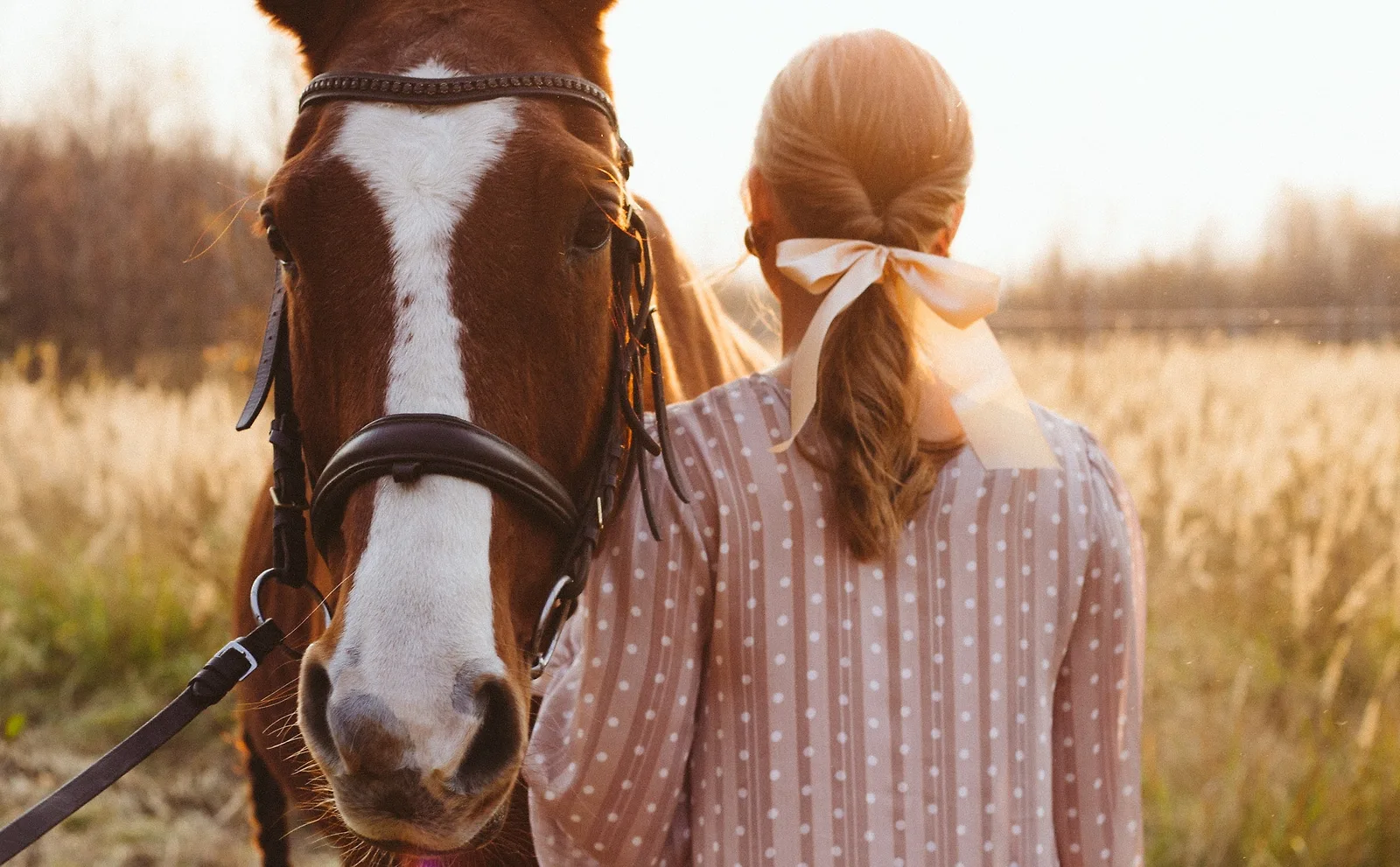
- The golden field, from behind. In The Rider's golden-field frame, the woman stands with her back to us, a cream satin ribbon tied into her braid, while the chestnut horse beside her looks straight into the lens. The horse becomes the face of the picture, and nobody has to pose. Shoot it in golden hour, from about 40 minutes before sunset, with the sun behind them; be set up an hour before.
- Cheek to cheek. Indoors, in soft window light, she rests her cheek against the horse's face and both look toward the camera. The white blaze leads the eye down the frame. This one needs a horse that is relaxed about faces near its head.
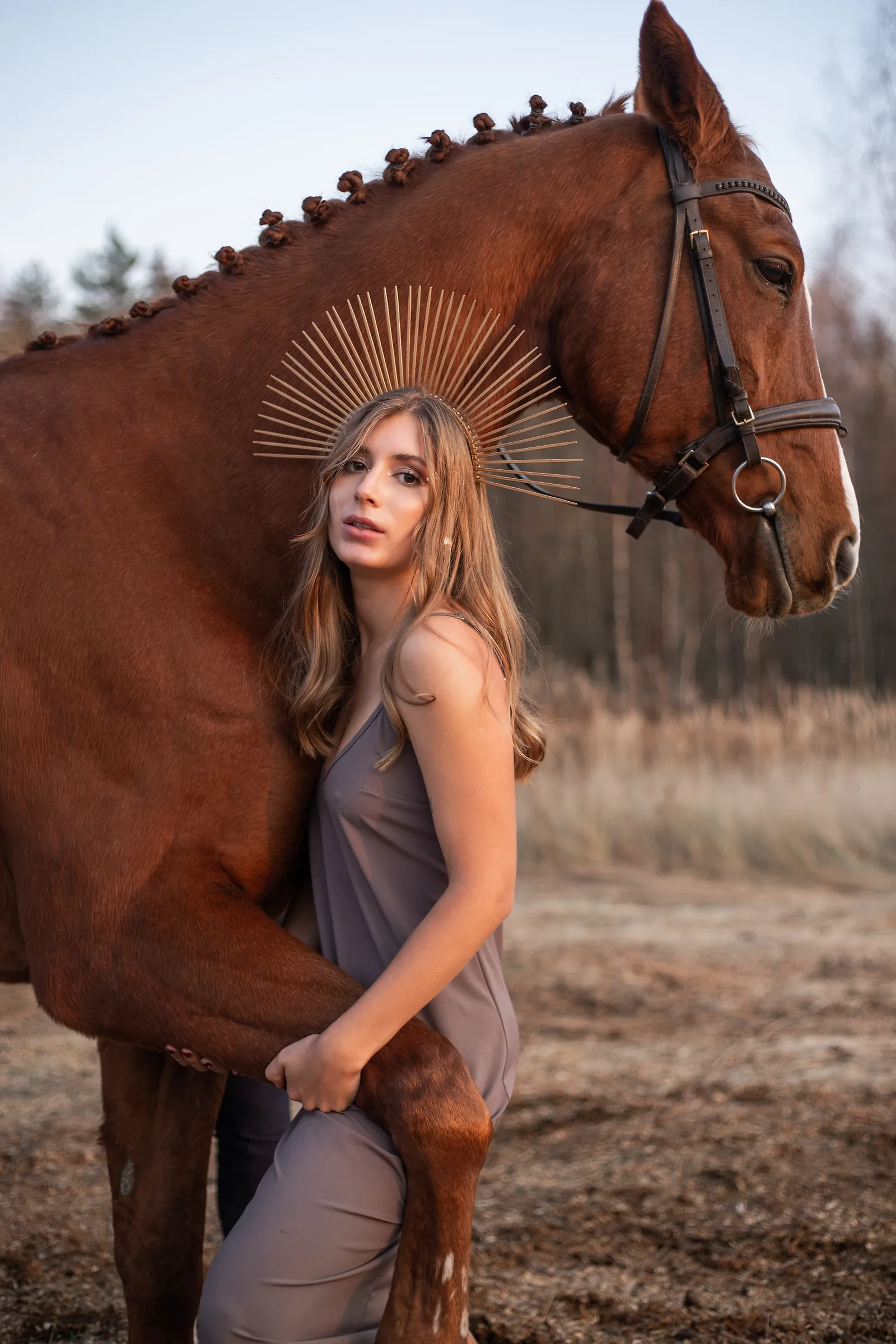
- The arena portrait. A full-length frame from a low angle, with the horse side-on behind her and the roof beams of a round arena radiating overhead. An oversized sage blazer, dark jeans and boots keep the look sharp against warm wood and sand.
- Over the shoulder. She stands with her back half-turned and looks back over a bare shoulder, one hand resting on the horse's neck, the horse's head filling the other side of the frame. It's a fashion pose that works only because the horse stands quietly.
- The quiet kiss. In profile, backlit, she brings her lips to the horse's nose with one hand on its face. Keep it to horses who know the person well, and keep hands flat and away from the mouth.
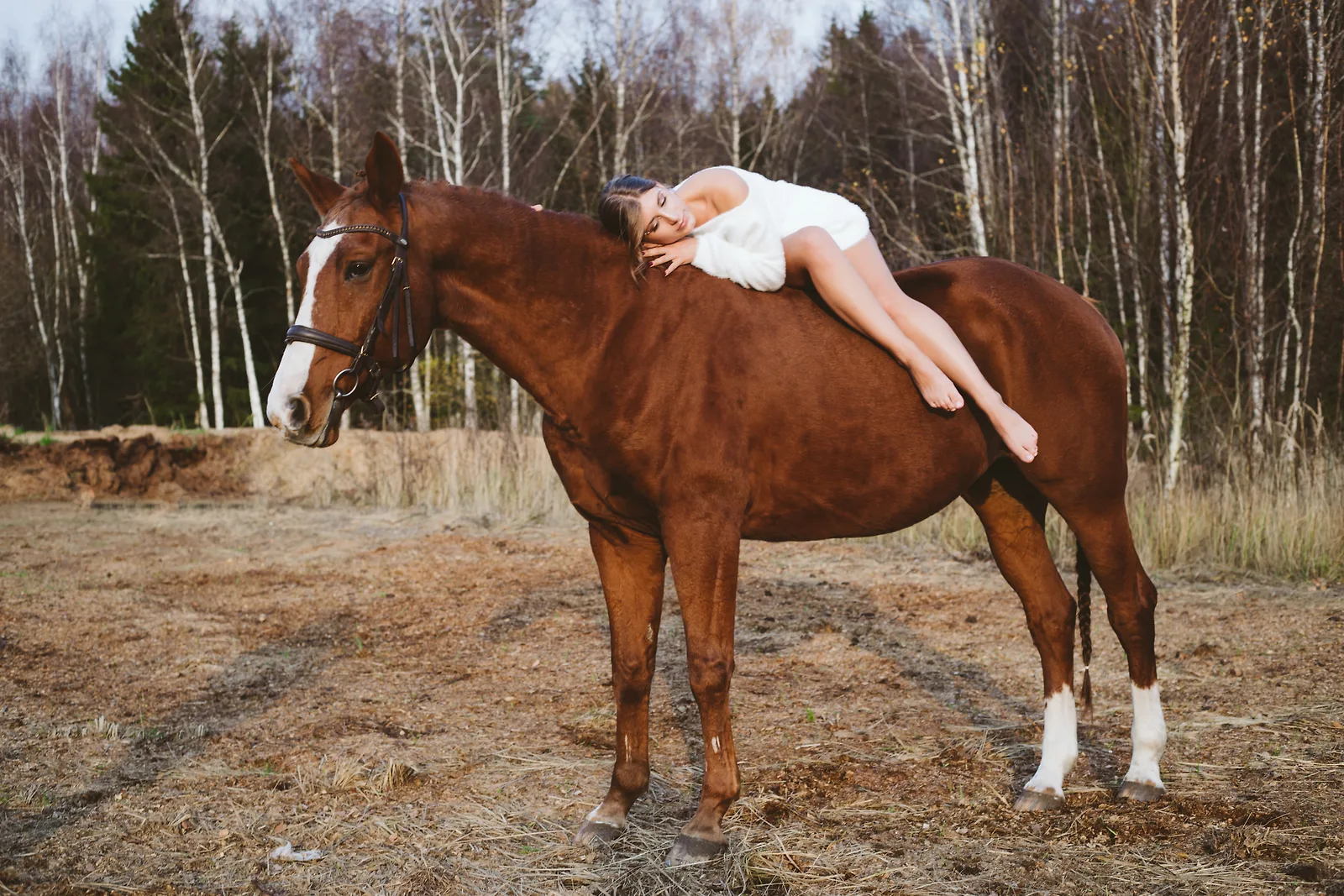
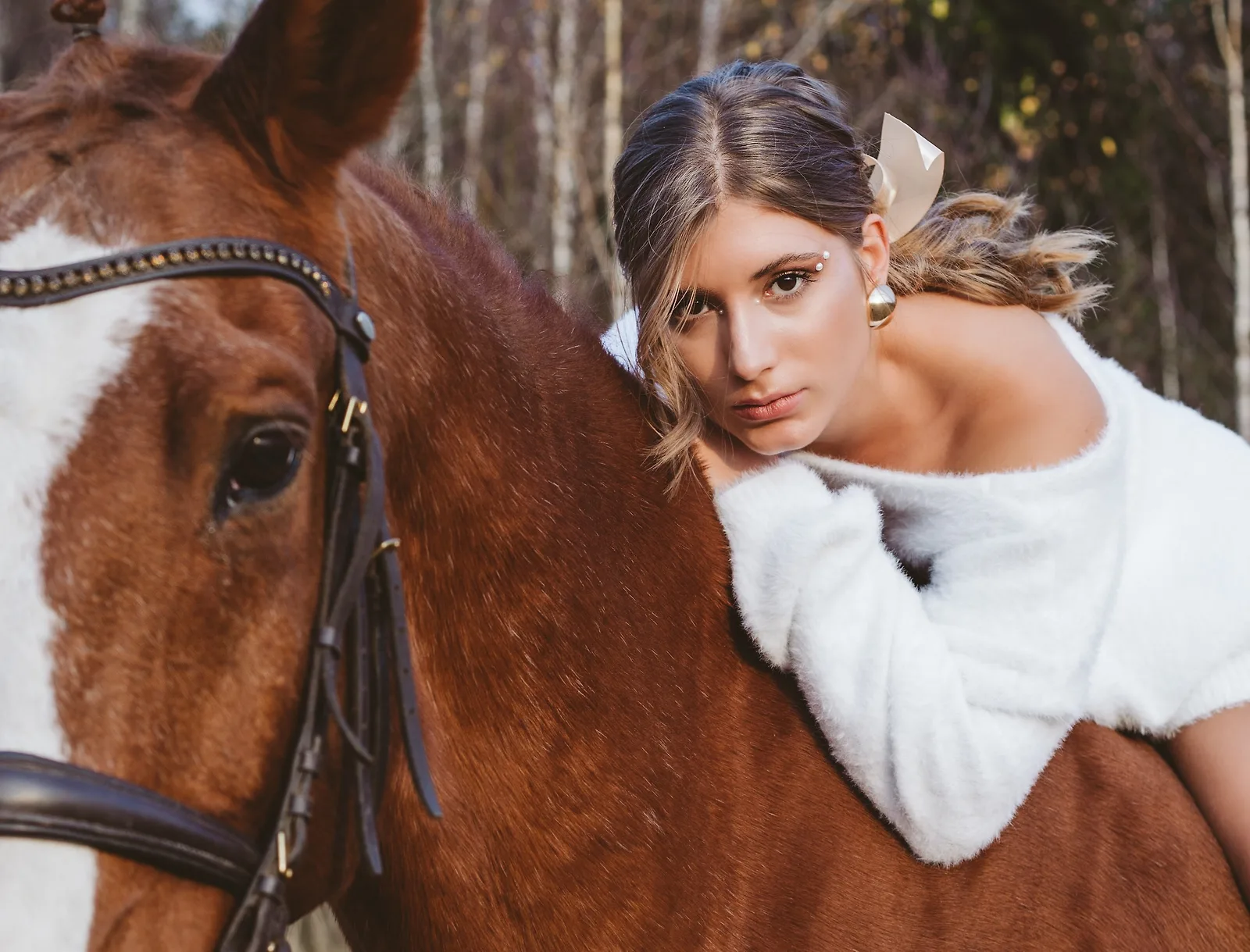
- Leaning on the neck. Draped over the horse's neck in a fluffy white sweater, she looks straight into the lens. Birch trunks and the last yellow leaves soften the background, and the light is even and grey.
- The sun in the frame. Put the low sun right behind the horse's ear and let it flare. Expose for the faces, not the sky, and accept a little haze; that glow is the point.
- Silhouettes. After the sun has gone, horse and person in profile against an orange sky. Expose for the sky and keep a little space between the horse's head and the person, so the shapes don't merge.
- Details. A hand on the white blaze, a braided mane, the eye and its lashes, boots and hooves in the sand, leather and buckles. Two or three detail frames make a set feel like a story.
- One moment of movement. The peak frame of The Rider is a horse rearing at the forest edge with its rider sitting composed on top; she is a professional horsewoman. Never ask a horse for that on a shoot; it belongs to a trained horse, its rider and its owner. A walk on a loose rein or a trot past the camera gives you movement without the risk.
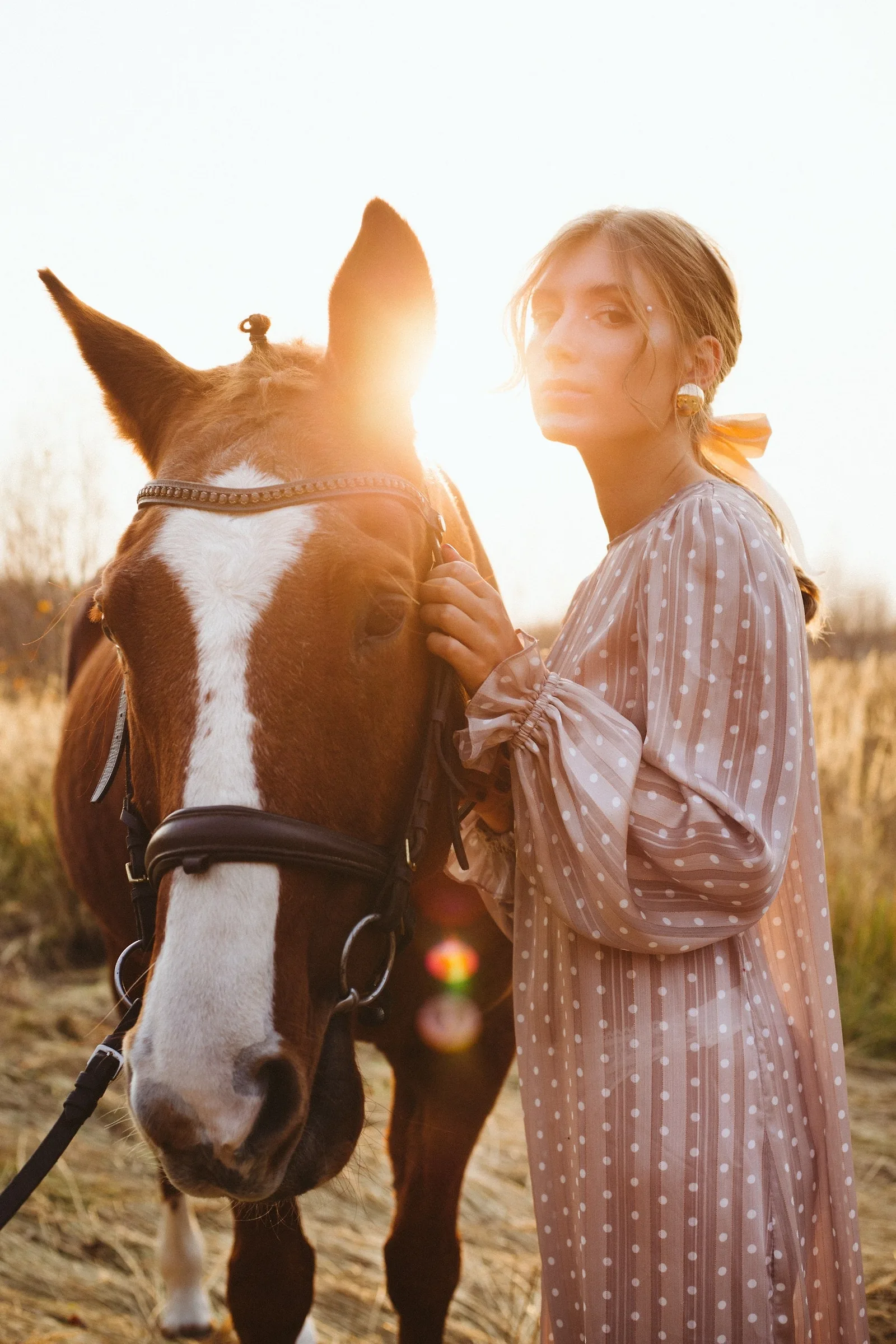
Idea 7 in practice: the low sun sits behind the horse's ear and flares, while both faces keep their detail.
How to work safely with horses on a shoot
A horse is a prey animal weighing several hundred kilograms, and a photoshoot puts new people, objects and noises around it all at once, so the rules below come before any picture.
- The owner, or a handler the horse knows, holds the lead for every frame. Their call always beats the photographer's.
- Ask about the horse before the day. How is it with strangers, cameras, dogs, umbrellas and flapping fabric? What spooks it? Choose a calm, experienced horse over a beautiful nervous one.
- Approach at the shoulder, talking calmly. A horse has a blind spot directly in front of and under its head and cannot see directly behind its body unless it turns its head, so never walk up to its nose or stand behind it.
- Give the horse space. A 70–200 mm lens lets the photographer work from several metres away, out of reach of the hind legs and out of the horse's path if it moves suddenly.
- Introduce new objects slowly, or leave them out. Horses react quickly to unfamiliar sights and sudden movements, like a reflector that pops open, an umbrella, a long veil or cape in the wind, or a drone overhead. Researchers use a suddenly opening umbrella to test how horses react to a startling object. Show the horse anything new from a distance first, with the handler's OK.
- Treat flash as a new object too. We could not find a controlled study on camera flash and horses, and photographers' reports are mixed. Start with natural light. If you need flash, the handler decides, and you fire it a few times from a distance before it goes near the horse.
- Keep it quiet. Use the camera's silent shutter while the horse settles, and no shouting, clapping or running toward the horse. For a walk or trot past the camera, check a test frame, because on many cameras the silent (electronic) shutter reads the picture line by line and fast legs can come out bent.
- Check the footing. Level, dry ground with no holes, rocks or wire; arena sand is ideal. Everyone near the horse wears closed boots, never sandals.
- Work in short sets. Give the horse breaks, water and shade. Stop if its ears pin back, its tail swishes hard, or the handler says so.
- For ridden frames, only use a rider who already rides that horse, wearing their usual safety gear. Stay at a walk or a standstill unless the rider and owner decide otherwise. Many stables ask for a signed waiver, so ask in advance.
What to wear for a horse photoshoot
Start from the horse's coat. In The Rider, the horse is a chestnut with a white blaze, and every outfit sits beside that warm red-brown: sage, dusty mauve, cream and white, with gold earrings repeating through the set.
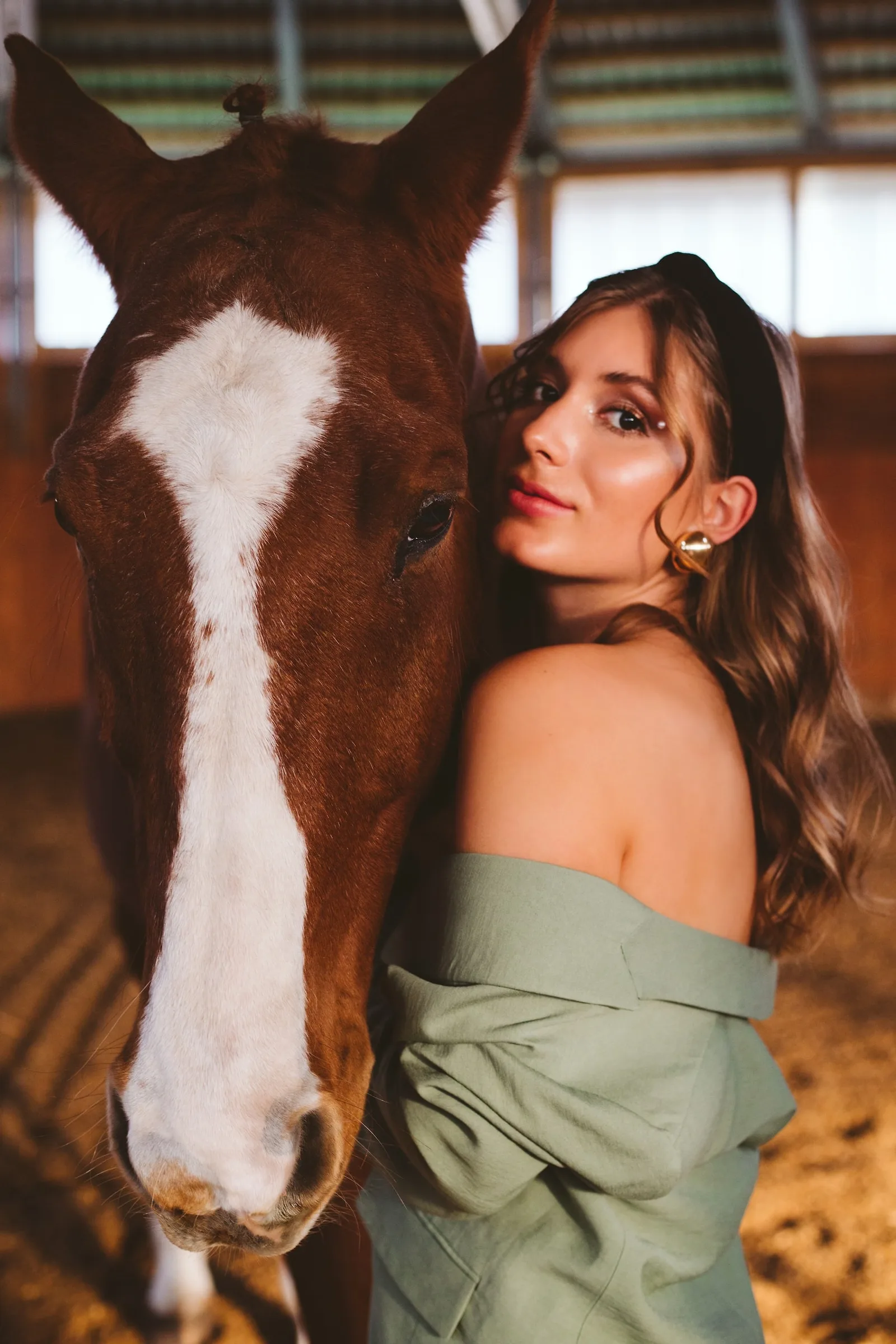
- Chestnut or bay: sage, olive, cream, dusty pink, denim.
- Black or dark bay: lighter neutrals, camel and soft colour, so the horse doesn't swallow the outfit.
- Grey or white: deeper tones, such as navy, burgundy or forest green, so the person doesn't vanish into the coat.
- Avoid exactly the coat's colour, or you and the horse become one shape.
- Fabrics with texture photograph well: knits, linen, denim, satin. Fluffy sweaters pick up horse hair, so bring a lint roller.
- Flowing pieces (a long dress, full sleeves, a ribbon, a veil) look beautiful in wind and backlight. Test them near the horse first, at a distance, with the handler watching.
- Shoes: closed boots. Heels sink into sand and grass, and sandals have no place near hooves.
- Hair and jewellery: keep both tied back and small enough not to catch on the bridle.
- Riders: breeches, tall boots and a helmet for any mounted frame.
- The horse: grooming, braids and tack are the owner's decision. Nothing goes on the horse without their say.
The best light for horse photos
- Golden hour. In Toronto it starts 38 to 47 minutes before sunset (times for any date). With the sun low behind the horse, the coat and hair get a bright rim and the grass glows, as in The Rider's field frames. In Ontario, October brings the same dry gold grass and turning birches, with the low sun early in the evening.
- Overcast. A grey sky works like a giant softbox, so the light is even, the colour stays rich and nobody squints. The birch frame below was shot under one.
- An indoor arena with big windows. It gives soft, directional light and a warm wooden background, and it doesn't care about the weather. In an Ontario winter it is often the most practical choice.
- Midday sun. Avoid it in the open; find the shade of a barn or trees.
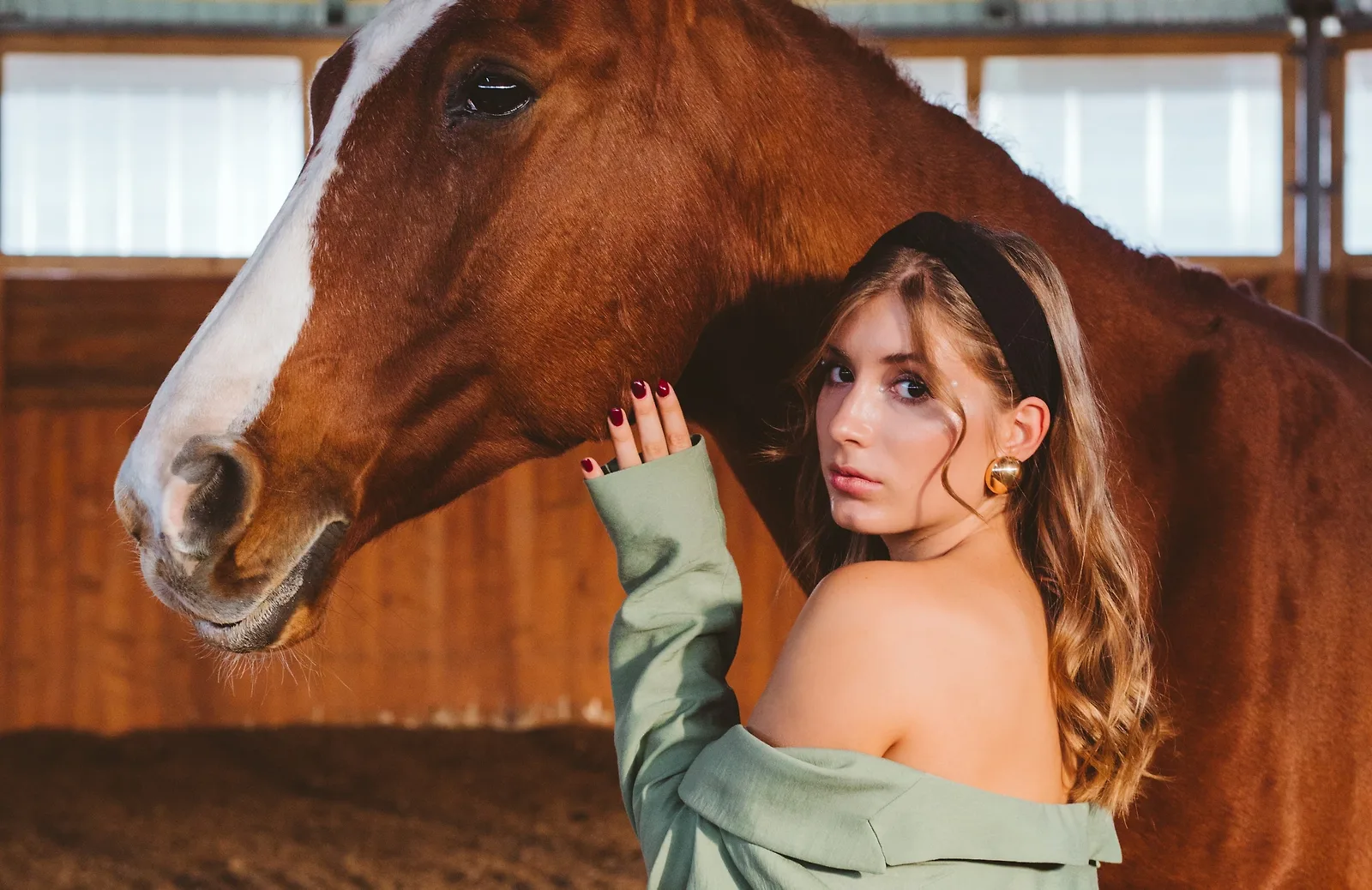
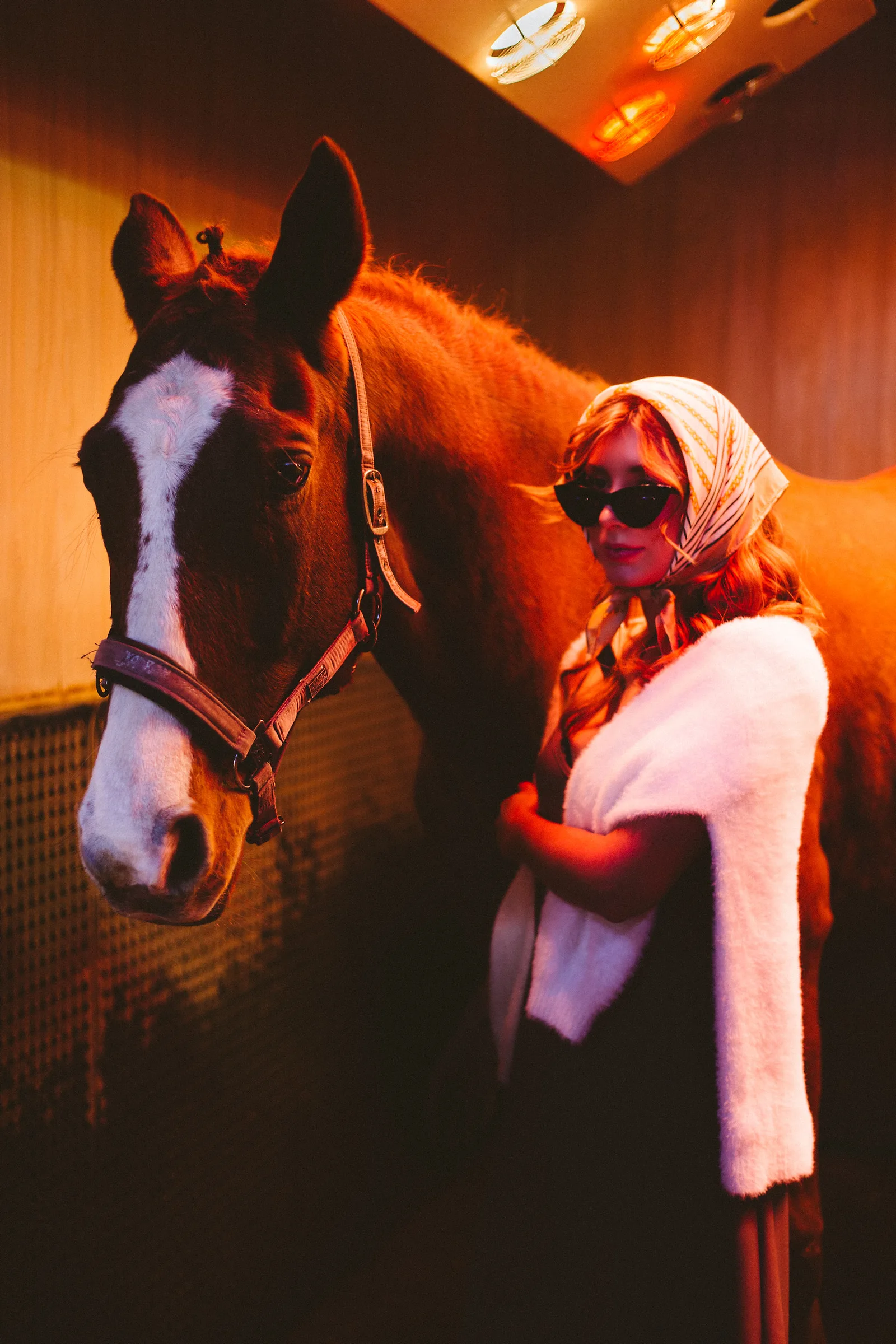
Here the arena's big windows, at the top of the frame, give soft side light and a warm wooden background. She stands at the horse's neck, where it can see her.
Coat colour changes the exposure. A chestnut glows in warm light, and a black horse needs light from the side to show its shape. With a grey or white horse, watch for blown-out highlights.
Camera settings that work:
- Lens: 70–200 mm for distance and flattering proportions. A wide angle close to a horse's head makes the nose look huge.
- Portraits: f/2.8 to f/4, focused on the nearest eye.
- Shutter: 1/500 s for a walk, 1/1000 s or faster for a trot or canter.
- Ears forward: ask a helper behind you to call the horse's name softly or rustle a feed scoop, whatever that horse responds to calmly.
Where to find a horse for a photoshoot in Ontario
- Your own horse or a friend's is the best start, because a horse that knows its person relaxes into the pictures.
- A boarding barn, with permission from both the owner and the barn manager. Barns set their own rules about visitors and photographers.
- A riding school or stable that offers photo time with its own horses and staff. Ask directly what their horses are used to.
- Never approach or photograph horses in a field without the owner. It is their property and their animal, and you don't know the horse.
To see show horses up close in Toronto, go to the Royal Agricultural Winter Fair, home of the Royal Horse Show, from November 6 to 15, 2026, at the Enercare Centre at Exhibition Place. Check the fair's own rules on cameras before you go.
FAQ
What should I wear for a photoshoot with a horse?
Pick colours that suit the horse's coat without matching it. Sage, cream and dusty pink work with a chestnut, and deeper tones with a grey. Wear closed boots, keep hair and jewellery tied back, and test anything that flows in the wind near the horse first.
Is flash photography safe around horses?
We couldn't find a controlled study either way, so treat flash like any new object. Start with natural light, and use flash only if the handler agrees, firing it a few times from a distance first.
How do you get a horse to put its ears forward in photos?
Ask a helper standing behind the photographer to call the horse's name softly or rustle a feed scoop. The owner will know what that horse responds to without getting excited.
What is the best time of day for horse photos?
Golden hour, which starts about 40 minutes before sunset, when the light is low and warm and comes from behind the horse. An overcast day or an indoor arena with big windows also works well.
Where can I do a photoshoot with horses near Toronto?
With your own horse or a friend's, at a boarding barn with the owner's and barn manager's permission, or at a stable that offers photo time with its own horses and staff. Wherever it is, the owner or a handler stays on set. To see show horses up close first, the Royal Agricultural Winter Fair runs November 6–15, 2026, at Exhibition Place.
Plan an equestrian shoot
The Rider is one of our editorial stories, and our editorial photoshoot ideas cover the planning side of a shoot like it. See more editorial work, or tell us about your horse and your idea.
Sources
As of October 2026:
- Blind spots and reactions to sudden sights and sounds: Oklahoma State University Extension, Techniques for Safely Handling Horses (E-960)
- Approaching at the shoulder and speaking calmly: extension.org, Approaching a horse (University of Nebraska and Penn State specialists)
- The opening-umbrella startle test: Powell et al., Genes, 2023
- Royal Agricultural Winter Fair dates and venue: Exhibition Place and The Royal Agricultural Winter Fair