Torontohenge 2026: Dates, Best Streets and How to Photograph It
Disolo Art · Updated
Torontohenge 2026 runs October 21–25. On Sunday, October 25, the setting sun sits in the middle of Queen and King at 6:16 p.m.; on the evenings before, it lines up a little earlier and higher.
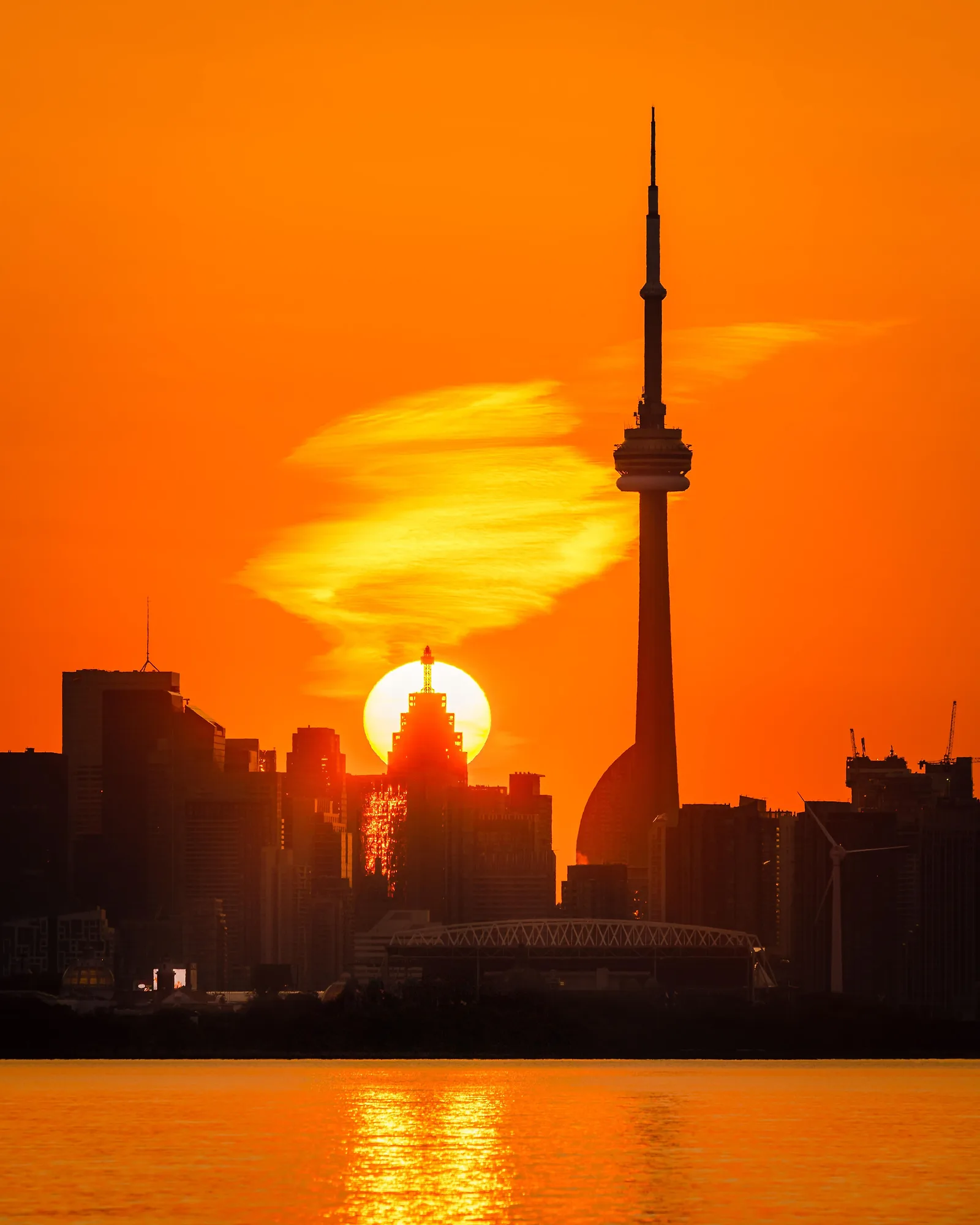
Torontohenge is the handful of evenings each year when the setting sun lines up with Toronto's east–west streets and shines straight down them between the towers. In 2026 it peaks on Sunday, October 25, when the sun sits in the middle of Queen and King streets downtown at about 6:16 p.m. EDT, two minutes before sunset. On the four evenings before it, October 21 to 24, the sun lines up a little higher between the towers, so any of them can give you the shot. From October 26 it no longer lines up, and the next sunset Torontohenge is February 15–19, 2027.
These are our own calculations, made from the measured angle of each street (more on that below). They match the date that Toronto sun-position specialist Ralph Bouwmeester gives every year: October 25, at about 6:18 p.m.
Torontohenge 2026 dates and times by evening
The sun's setting point moves about half a degree along the horizon each day, roughly its own width, so the alignment holds for a short run of evenings. In October, each evening before the peak lines the sun up a little higher above the horizon and a minute or so earlier.
On downtown Queen and King (Yonge to Spadina), the sun is exactly in the street at these times:
- Wednesday, October 21: 6:11 p.m., sun about 1.7° above the horizon (three sun-widths up)
- Thursday, October 22: 6:12 p.m., about 1.3° up
- Friday, October 23: 6:14 p.m., about 0.8° up
- Saturday, October 24: 6:15 p.m., about 0.4° up, the whole disc just clear of the horizon
- Sunday, October 25: 6:16 p.m., the sun's centre on the horizon; sunset is at 6:18 p.m.
- Monday, October 26 onward: the sun sets a little left of the street's line and slides behind the buildings on the south side
On other streets:
- Bloor Street West near Yonge: best on October 23 and 24, at about 6:16–6:17 p.m.
- Queen and King west of Spadina (Queen West, King West): best October 21–23, at about 6:17–6:20 p.m.
Which evening looks best on your corner depends on what stands at the far end of the street. With an open view right down to the horizon, Saturday and Sunday are the classic shot. If buildings or trees close off the far end, the sun reaches them before it reaches the horizon, so Thursday or Friday will give you the full disc in the gap. The safe plan is to go out from Thursday to Sunday and take the clearest evening.
Why Torontohenge happens
Toronto's grid was laid out parallel to the Lake Ontario shore, not to the compass. We measured the downtown blocks of Queen and King from OpenStreetMap: they run 16.6° south of due west, a bearing of 253.4°. In late October and again in mid-February, the sun sets at exactly that bearing, so it shines straight down the street between the towers. In April and August the sun rises at the opposite bearing, and the effect repeats at sunrise, looking east. The name borrows from New York's Manhattanhenge.
Websites give different dates, sometimes two or three days apart, for three reasons:
- Definitions. Some count the evening the sun's last sliver vanishes inside the street. Others count the evening the whole disc stands above the horizon, which comes a day or two earlier in October.
- The streets bend. Around Peter Street and Spadina, Queen and King turn about one degree to the north. One degree is two days, so the blocks west of Spadina line up two days before the downtown blocks.
- The skyline at the end of the street. The ground itself is nearly flat along these sightlines (no more than about 0.2° on Natural Resources Canada's elevation data). But a row of buildings one degree high at the far end moves the best evening by about two days.
Best streets and where to stand
Stand on the sidewalk at a corner with a clear view west, ideally with tall buildings on both sides of the street.
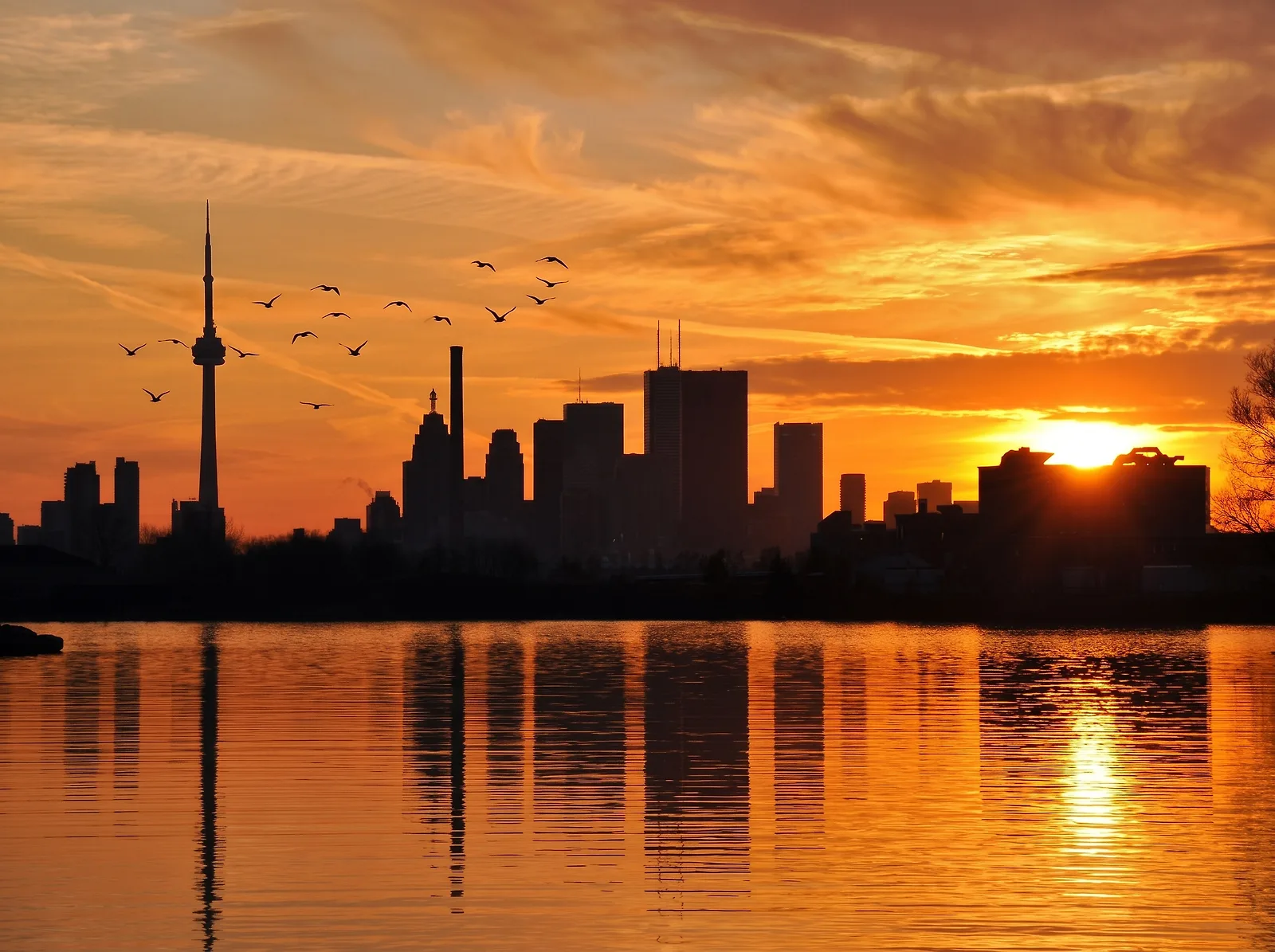
- King Street West, Yonge to Spadina. Financial District towers line both sides between Yonge and University, so the canyon around the sun is deep and dark. The Weather Network singles out the stretch outside Roy Thomson Hall, at King and Simcoe.
- Queen Street, both sides of Yonge. Queen East from Yonge to about Jarvis runs on the same bearing as Queen West to Spadina. You can stand near Church Street and look west along well over a kilometre of straight street with a long lens.
- Richmond, Adelaide and Wellington West. These parallel streets are lined with towers. They have small jogs, so the best evening can differ by a day.
- Bloor Street West at Yonge or Bay. The northern option, with the towers around Yonge and Bay framing the view. Bloor lines up about a day before downtown Queen and King.
- Expect less from Dundas, which bends near University Avenue, so its straight run west of Yonge is short.
Stay out of the road
The photo is not worth a step into traffic. Drivers heading west look straight into the sun at this hour, so a person in the road can be hard to see.
- Shoot from the sidewalk or a corner. Never stand in a live lane, on streetcar tracks or in the middle of King to centre the sun.
- King Street between Bathurst and Jarvis is a transit priority corridor with frequent streetcars. Never step in front of a streetcar (the TTC warns that the operator may not see you, and that is before the glare), and keep clear of riders getting on and off. Between 2014 and 2024 the City recorded 141 collisions in which a driver illegally passed open streetcar doors and hit a pedestrian.
- Leave the crosswalk and the sidewalk free, and keep tripod legs tucked in.
- Protect your eyes. Don't stare at the sun, and never look at it through an optical viewfinder or binoculars with a long lens. Compose on the rear screen instead.
How to photograph Torontohenge
Arrive 30 to 45 minutes early. Find your corner and check the sightline. The light turns good about 20 minutes before the sun reaches the street, and the glow lasts a few minutes after it disappears.
Pick the lens for the story. A wide lens (24–35 mm) shows the whole canyon and the light running along the pavement. A telephoto from further east stacks the towers and makes the sun big. The sun is about half a degree wide, so at 400 mm on a full-frame camera it fills about a tenth of the frame's width; at 100 mm it is a small dot.
Expose for the sky, not the street. In the camera's normal metering mode, start at −1 EV and bracket down to −2 EV; with a spot meter, read the sky a sun-width or two beside the sun and use that reading as it is. Let the sun itself clip to white and keep colour in the sky around it. When the sun just touches a building's edge, f/11 to f/16 turns it into a star.
Keep the warmth. Set white balance to Daylight (around 5,500 K). Auto white balance tries to neutralize the orange and flattens the scene.
Freeze or blur the street. At 1/250 s or faster, people and streetcars become crisp silhouettes in the beam. A slower shutter on a tripod turns traffic into streaks, but only if the tripod stays out of everyone's way. At this hour the sky still meters bright: at ISO 100 and f/16 you'll be near 1/30–1/125 s, so for streaks at 1/4 s or longer you need a 3- to 6-stop ND filter.
On a phone, use the 2× or 3× lens and tap the sky beside the sun. Then drag the exposure slider down until the sky holds its colour, and shoot a burst as people cross the light.
Look for people in the beam. The low sun throws long shadows down the sidewalk and lights one side of every face. Walkers crossing the light at a corner turn into silhouettes with glowing edges, and glass towers bounce a second, softer sun back into the street.
If it's cloudy
The alignment runs over several evenings, so check Environment Canada's forecast and choose the clearest evening between October 21 and 25. For today's sunset time and the sun's direction from any corner, use our Toronto golden hour tool. A band of cloud low in the west can hide the disc but still turn the whole street orange; a gap just above the horizon is enough for the beam.
To plan the evening, open the photoshoot planner for October 25, which has the light, the rule for shooting on the sidewalks and a packing list.
If October stays grey, the next chances are:
- February 15–19, 2027, at sunset (about 5:41–5:47 p.m. EST). In February the order is reversed: the downtown blocks line up first, on the 15th, and the sun stands a little higher each evening after that. Bloor joins from the 16th and the blocks west of Spadina from the 17th.
- April 20–24, 2027, at sunrise (about 6:28–6:33 a.m.), looking east.
- August 19–23, 2027, at sunrise (about 6:31–6:38 a.m.), looking east.
If you plan for February, check the TTC's project page before you choose a corner. From November 1, 2026, King West between Portland and Spadina is under construction, with work planned into August 2027, and the 504 King streetcar runs along Queen West instead.
FAQ
What time is Torontohenge on October 25, 2026?
The sun sits in the middle of Queen and King downtown at about 6:16 p.m. EDT and sets at 6:18 p.m. (our calculation for Queen and Bay). Be in place by 5:45 p.m.
Where is the best place to see Torontohenge?
King Street West between Yonge and Spadina, especially outside Roy Thomson Hall. Queen Street on either side of Yonge, Richmond, Adelaide, Wellington and Bloor Street West at Yonge also work. Stand on the sidewalk with a clear view west.
How long does Torontohenge last?
On any one evening, the sun stays inside the gap for a few minutes. Each street gets four or five usable evenings: in October they end on the alignment date, in February they start on it.
Is there a Torontohenge sunrise?
Yes. Around April 20–24 and August 19–23 the sun rises along the same streets. Stand west of Yonge and look east at about 6:30 a.m.
When is the next Torontohenge after October 2026?
February 15–19, 2027, at sunset. On the 15th the sun lines up at about 5:47 p.m. EST, right at the horizon; each evening after, a little higher and earlier, about 5:41 p.m. by the 19th.
Why do websites give different Torontohenge dates?
They define the moment differently and measure the streets at different points: the downtown blocks and the blocks west of Spadina are two days apart. We give the time the sun is exactly in the street on each evening.
Portraits in Torontohenge light
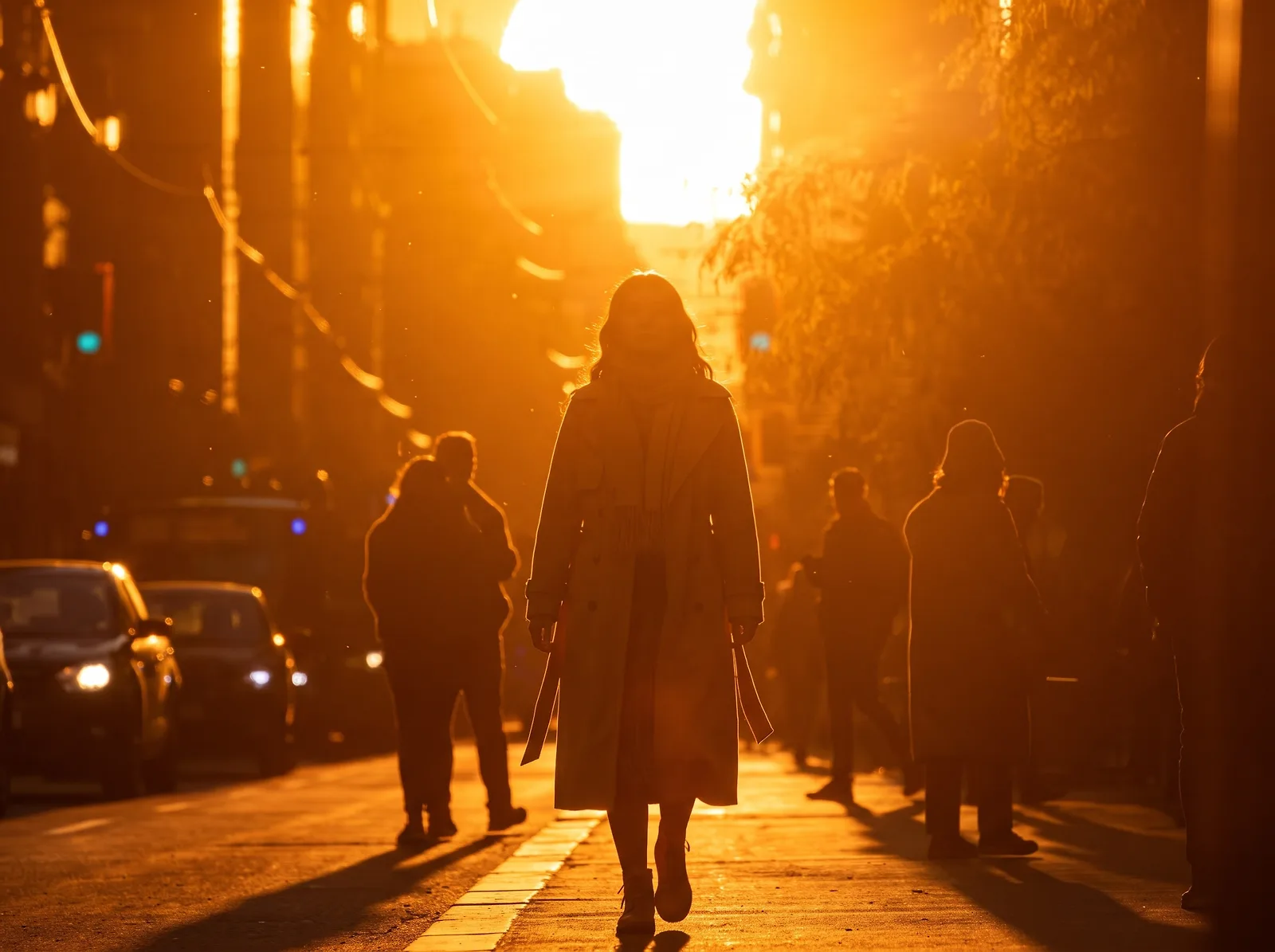
For a portrait, stay on the line of the sun but out of the crowd, at a corner of the main street or on a quieter parallel street such as Wellington, which runs on the same bearing. There the low sun becomes a rim light. It outlines hair and shoulders while the face takes the softer light bouncing off the buildings across the street. North–south side streets are already in shadow at this hour.
You don't need the peak evening for a portrait. From mid-October the evening sun already runs down the same streets inside golden hour, a little higher each evening before the peak: October 18 at 6:07 p.m., 3° up; October 20 at 6:10 p.m., 2° up. It clears more of the buildings at the end of the street, and it's easier on a face.
If you're planning a shoot in this kind of light, see our portrait photography, check whether your shoot needs a permit and tell us about your idea.
Sources
All dates and times in the article are our calculations unless marked as reported. As of October 2026:
- Reported dates (October 25 and February 15) and the "top edge grazes the horizon" definition: Ralph Bouwmeester, Sun & Shadow Modeling
- Reported 2026 dates and times: Curiocity, January 27, 2026 and Streets of Toronto, February 12, 2026
- Vantage points, the lakeshore grid and the advice to stay off the road: The Weather Network, October 23, 2025
- An independent per-street calculator: sunnytracker.com, Toronto Henge
- Street geometry: OpenStreetMap contributors. Sun position: NOAA Solar Calculator formulas, cross-checked with the JPL DE421 ephemeris. Sunset times can be checked with the NRC sunrise/sunset calculator
- Terrain: Natural Resources Canada, Canadian Digital Elevation Model
- King West construction and the 504 diversion: TTC, King Street West Track Renewal
- Streetcar-door collisions: City of Toronto, enhanced pavement markings at streetcar stops; streetcar safety: TTC, bus, streetcar, subway and station safety tips
- Forecast: Environment and Climate Change Canada, Toronto